You are here

sheeloopoonam@yahoo.com's blog

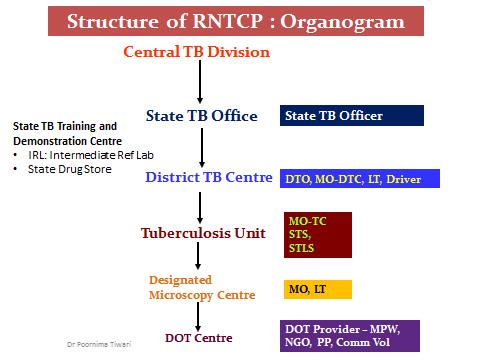
RNTCP Structure

RNTCP Structure
The structure of RNTCP comprises of 5 levels
1. National
2. State
3. District
4. Sub – District
5. Peripheral health institutions

1. National: Central TB Division
• Programme Manager/DDG(TB)
• Plans/Supervises/Monitors/Evaluation
• National Committee on TB Diagnosis and Treatment
• National Laboratory Committee
• National Technical Working Group for TB/HIV
• National Institutes Etc.

5 Components of DOTS strategy

• DOTS strategy had 5 main components:
1. Political will (therefore administrative commitment) (C)
2. Diagnosis by quality microscopy of sputum (M)
3. Adequate drug supply (S)
4. Directly observed treatment (O)
5. Accountability – systematic monitoring (A)
Thus RNTCP shifts the responsibility for cure from the patient to the health system
Suggested Mnemonic: SCAM – O

Evolution of Revised National TB Control Program (RNTCP)

• The National Tuberculosis Programme of India (NTP) was initiated in 1962 and was originally designed for
– Domiciliary treatment, using self- administered standard drug regimens.
• A review of the programme in 1992 concluded that the NTP was poorly managed, inadequately funded and could not achieve TB control
– Treatment success rates was unacceptably low
– Over-reliance on X – ray for diagnosis
– frequent interrupted supplies of drugs
– Default rates remained high
– Death rates due to TB were still high

TB Control Faces Daunting Challenges in India

• Decades of unrestrained transmission has left hundreds of millions of Indians with latent TB infection, which may re-activate at any time.
• A significant proportion of the population is undernourished, which weakens immunity and drives TB reactivation.
• A considerable number more suffer from risk factors for tuberculosis,
– Diabetes,
– Indoor air pollution from cook stoves, or smoking.
• The dense, growing urban environment facilitates the transmission of the disease cutting across all economic strata.

TB in Pregnancy and Lactation

Before initiating treatment for TB in women, she should be asked about current or planned pregnancy
• EXCEPT Streptomycin, all first line anti –TB drugs are safe for use in pregnancy
–Streptomycin is ototoxic to the fetus and should not be used during pregnancy

In case of MDR –TB: Test for pregnancy
• If not pregnant advised to use birth control
– OCPs should be avoided
– Use of barrier methods or IUD is recommended

Integrated Management of Neonatal and Childhood Illness (IMNCI)

IMNCI (Integrated Management of Neonatal and Childhood Illness) is India’s adaptation of the WHO–UNICEF IMCI strategy. It focuses on children under five, especially newborns, using evidence-based, syndromic case-management charts. The approach improves assessment, treatment, referral, caregiver counselling and health-system readiness at first-level facilities.

Role of Genetic Predisposition in Common Disorders

• Some traits like intelligence, physical ability and longevity are genetically determined but the effect of external and environmental influences are the main determinants of health and survival
• With increased control of environment, genetic makeup is becoming more important determinant of individual health
• Genetic predisposition may lead to the premature onset of common diseases of adult life such as
– Cancer
– Coronary heart disease
– Diabetes
– Hypertension and
– Mental disorders
• Cancer:

Erythroblastosis Foetalis

• This occurs:
– If the fetus is Rh positive and
– mother is Rh negative

• Some fetal red cells cross the placenta and enter maternal circulation in all pregnancies
– The Rh +ve fetal cells act as foreign antigen and stimulate production of Rh antibodies in the Rh negative mother

• The Rh antibodies are of two main types:
– The ‘strong’ or saline antibodies and
– The ‘weak’ or albumin antibodies: these are small 7s gamma globulins which can cross the placental barrier.

Gene therapy

It is the introduction of a gene sequence into a cell with the aim of modifying the cell’s behaviour in a clinically relevant fashion

It may be used in several ways, e.g.
o To correct a genetic mutation (as for cystic fibrosis),
o To kill a cell (as for cancer) or
o To modify susceptibility (as for coronary artery disease)

Pages

Subscribe to RSS - sheeloopoonam@yahoo.com's blog