
You are here

sheeloopoonam@yahoo.com's blog

Septic Tanks: How do these work?

A septic tank is an underground excreta (sewage) treatment system used in rural or suburban areas where there is no access to a centralized sewer system.
It’s a self-contained tank that collects and treats the human waste from one or more homes.
It is buried in the ground near the home/s. Think of it as the "middleman" between the excreta and the environment, filtering out harmful substances before the treated water is released back into the soil.
The tank is usually made of concrete, though fiberglass or plastic tanks are now available.
RCA Latrine

What Makes Up an RCA Latrine?
Whether it's the PRAI or RCA type, both have the same essential parts — only the technical details differ slightly. You’ll typically see:
1. A squatting plate
2. A pan for excreta reception
3. A trap for maintaining water-seal
4. A system positioned after the water seal, for safe and hygienic excreta disposal
 Connecting pipe
 The Pit (Dug-well)
5. A super-structure

Water-seal latrine

A beginner-friendly explanation of the water seal used in toilets and latrines—how the curved trap holds water, blocks foul gases, stops flies, and improves hygiene. The blog covers the science behind the water seal, its use in rural sanitation systems, connections to pits, septic tanks, and sewers, and proven designs like RCA and PRAI latrines widely used across India.

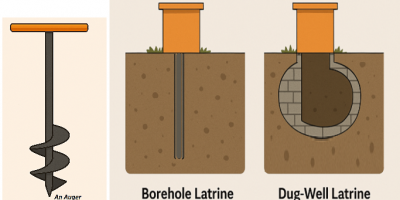
The Dug Well Latrine (Pit Latrine): A More Practical Alternative to the Borehole Latrine

The article outlines the shortcomings of traditional borehole latrines and introduces the dug-well latrine as a practical and scalable sanitation solution. It covers pit design, size, construction techniques, lining options, anaerobic digestion, and real-world usability. It also highlights innovations like ventilated improved pit (VIP) latrines, water-sealed pits, and twin-pit systems that enhance hygiene and lifespan. Based on Indian community health & sanitation standards, the blog is useful for MBBS students, public health professionals, and WASH practitioners.

Bore-Hole Latrine

The bore-hole latrine, introduced under the Rockefeller Foundation’s hookworm control program, marked a major transition from service-type latrines to sanitary excreta disposal in India. The article describes how it was built using an auger, its structural reinforcements, the anaerobic digestion process, its advantages (no daily cleaning, fewer flies, safe if placed far from water sources), and major drawbacks like limited capacity, need for specialized equipment, and unsuitability in high water-table regions. This blog provides historically important insights for MBBS students, public health learners, and WASH professionals.

Proper Excreta Disposal: A Necessity for Health and Dignity

Improper excreta disposal is a major cause of fecal-oral disease transmission, leading to soil contamination, unsafe drinking water, food contamination, and fly-borne infections. This blog explains the pathogens commonly found in human excreta, the dangers of open defecation and service-type (conservancy) latrines, and why they are banned. It also describes the criteria for a sanitary latrine and outlines hygienic options for unsewered areas (borehole, pit, water-seal, RCA, PRAI, septic tank, aqua privy), sewered areas, and temporary camps. This content follows Indian public health guidelines and is ideal for MBBS students and community medicine learners.

Sanitary Latrine

This blog explains why understanding toilets is essential for every MBBS student. Sanitary latrines are among the most effective public health interventions, preventing fecal-oral diseases, reducing childhood stunting, lowering maternal and neonatal infections, and even helping control antimicrobial resistance. The article explains what makes a latrine “sanitary,” how a water-seal works, and why safe excreta disposal is foundational to community health. It also highlights practical toilet types—pit, borehole, septic tank, water-seal, aqua privy—and their role in disease prevention and dignity, especially for women and children.

Indoor Air Pollution: The Silent Thief in Your Living Room

Indoor air pollution is often more harmful than outdoor pollution, coming from everyday sources such as cooking fuels, gas stoves, VOCs from household products, mold, radon, and second-hand smoke. This blog explains the major pollutants inside homes, their health impacts—including heart disease, stroke, COPD, pneumonia in children, and lung cancer—and why women and young children in biomass-using homes are especially at risk. It also outlines essential actions such as clean cooking fuels, proper ventilation, strong building guidelines, and targeted research to reduce exposure. This is a practical, MBBS-friendly, public health–oriented guide.

Pages

Subscribe to RSS - sheeloopoonam@yahoo.com's blog