Duration of Pregnancy: Understanding the Trimesters and Gestational Age Categories
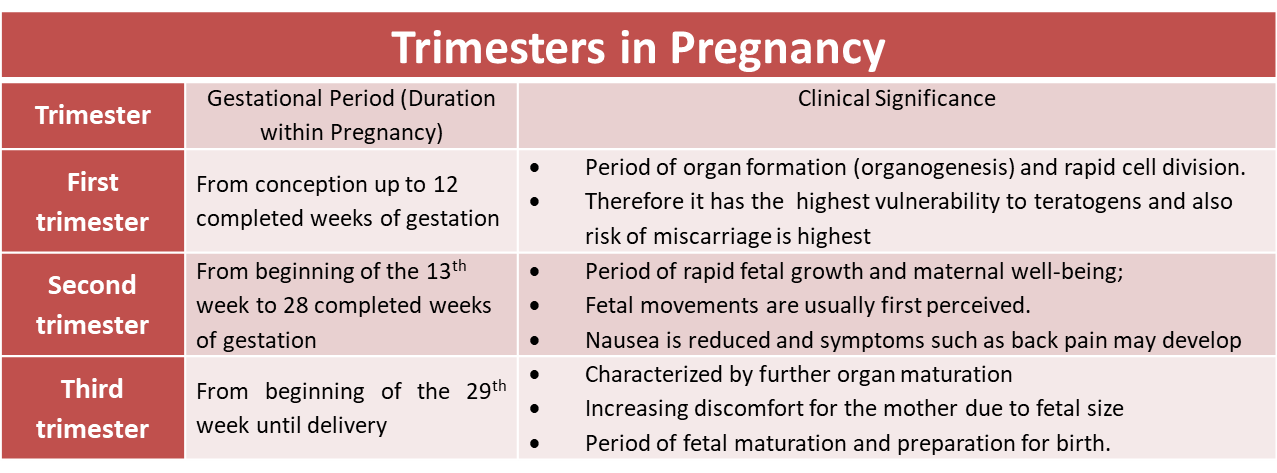
Pregnancy is divided into three trimesters, each marked by distinct phase of fetal development and maternal adaptation and physiological changes in the mother
| Trimesters in Pregnancy | Trimesters in Pregnancy | Trimesters in Pregnancy |
|---|---|---|
| Trimester | Gestational Period (Duration within Pregnancy) | Clinical Significance |
| First trimester | From conception up to 12 completed weeks of gestation | Period of organ formation (organogenesis) and rapid cell division. Therefore it has the highest vulnerability to teratogens and also risk of miscarriage is highest |
| Second trimester | From beginning of the 13th week to 28 completed weeks of gestation | Period of rapid fetal growth and maternal well-being; Fetal movements are usually first perceived. Nausea is reduced and symptoms such as back pain may develop |
| Third trimester | From beginning of the 29th week until delivery | Characterized by further organ maturation Increasing discomfort for the mother due to fetal size Period of fetal maturation and preparation for birth. |
Original image
Gestational Age Categories: Definitions and Clinical Significance
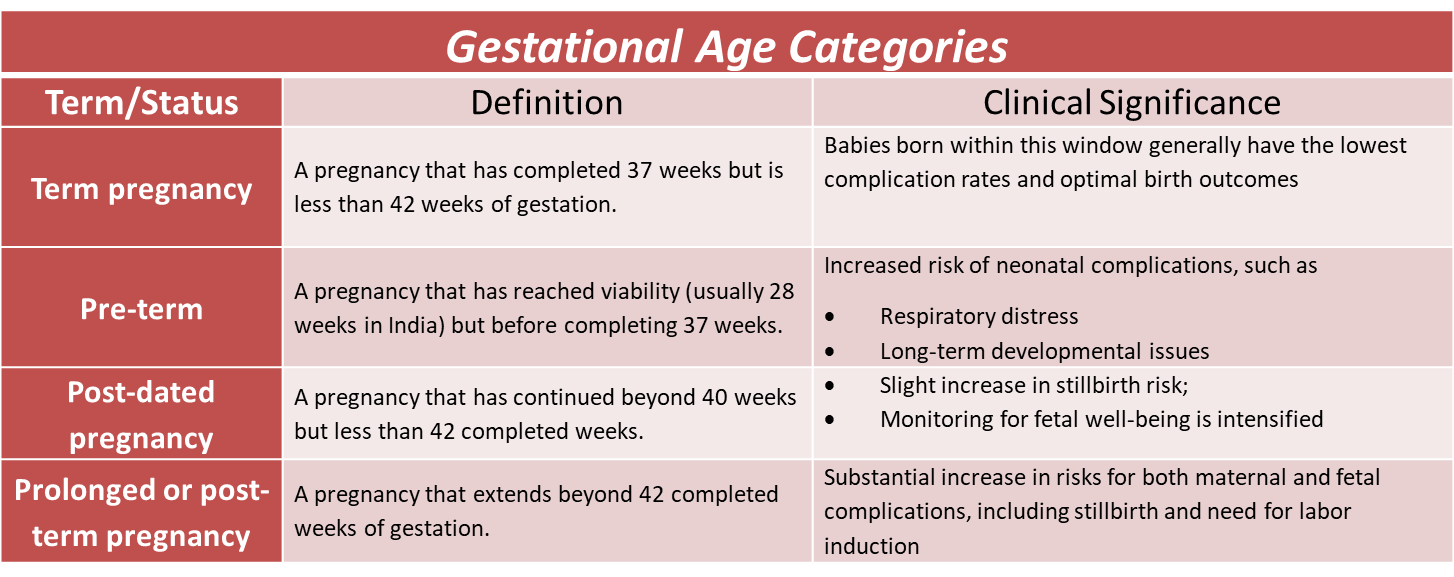
Pregnancy is often described based on the number of completed weeks of gestation.
Pregnancy outcomes and clinical management strategies depend heavily on the gestational age at delivery.
Each trimester and gestational age classification is important for decision-making regarding prenatal care, monitoring, and potential interventions. Preterm and post-term pregnancies are associated with higher risks and often require specialized evaluation and management to ensure favorable outcomes
| Gestational Age Categories | Gestational Age Categories | Gestational Age Categories |
|---|---|---|
| Term/Status | Definition | Clinical Significance |
| Term pregnancy | A pregnancy that has completed 37 weeks but is less than 42 weeks of gestation. | Babies born within this window generally have the lowest complication rates and optimal birth outcomes |
| Pre-term | A pregnancy that has reached viability (usually 28 weeks in India) but before completing 37 weeks. | Increased risk of neonatal complications, such as Respiratory distress Long-term developmental issues |
| Post-dated pregnancy | A pregnancy that has continued beyond 40 weeks but less than 42 completed weeks. | Slight increase in stillbirth risk; Monitoring for fetal well-being is intensified |
| Prolonged or post-term pregnancy | A pregnancy that extends beyond 42 completed weeks of gestation. | Substantial increase in risks for both maternal and fetal complications, including stillbirth and need for labor induction |
Original image
References:
- Dutta DC. Textbook of Obstetrics. 9th ed. New Delhi: Jaypee Brothers Medical Publishers; 2023.
- Padubidri VG, Daftary SN. Shaw’s Textbook of Gynaecology. 18th ed. New Delhi: Elsevier; 2022.
- Park K. Park’s Textbook of Preventive and Social Medicine. 28th ed. Jabalpur: Bhanot Publishers; 2025.
- Babu SA. Clinical Obstetrics and Gynecology. 2nd ed. New Delhi: Wolters Kluwer India Pvt Ltd; 2025.
5-Page ANC History Taking Format: 5-Page ANC History Taking Format: Essential Guide for Perfect Assessments
Why ANC History Taking Matters?
#Obstetric index (GPAL) in Antenatal Case History: Obstetric index (GPAL) in Antenatal Case History
#Decoding Gravida and Para: Terms in Antenatal History Taking: Decoding Gravida and Para: Terms in Antenatal History Taking
#Duration of Pregnancy: Understanding the Trimesters and Gestational Age Categories: Duration of Pregnancy: Understanding the Trimesters and Gestational Age Categories
#Calculation of Expected Date of Delivery (EDD) and Period of Gestation (POG): Calculation of Expected Date of Delivery (EDD) and Period of Gestation (POG)
#Antenatal Care and Case Booking: Antenatal Care and Case Booking
#Clinical Significance of Antenatal History Components (Socio-Demographic components): Clinical Significance of Antenatal History Components (Socio-Demographic components)
Antenatal History Taking: Significance of Clinical Components