NOISE and HEALTH
- NOISE- Unwanted sound
- Come to be a major “stress factor” in today’s life
- Noise Pollution = unwanted or excessive sound that can have damaging effects on human health,
- Sources of noise are varied:
- Automobiles
- Factories
- Air crafts etc.
- Levels particularly high around:
- Railway junctions,
- Bus depots
- Airports
- High Traffic areas etc.
• Noise has 2 characteristics:
-
Intensity or loudness
-
Frequency
-
Intensity (Loudness)
- Measured in decibels (dB)
- 60 dB sound means, 60 dB more intense then the lowest discernible noise (=reference)
- dBA is used instead of dB in case of human hearing as human responds not to the REAL loudness but to a PERCEIVED intensity.
- dB (A) denotes the perception of sound by the normal human ear
- dBA is calculated by ‘A’ using A weighted curve k/a ‘curve A’ which has been constructed to take into account, the subjective effect of the sound on a normal ear
2. Frequency:
- Measured in Hz
- Human ear can identify 20 to 20,000 Hz
- < 20 Hz = infra-audible
-
20,000 Hz = Ultra-sonic
- Some animals can hear sounds inaudible to human ear
- Phon: is an index of intensity whilst also taking into account, the frequency
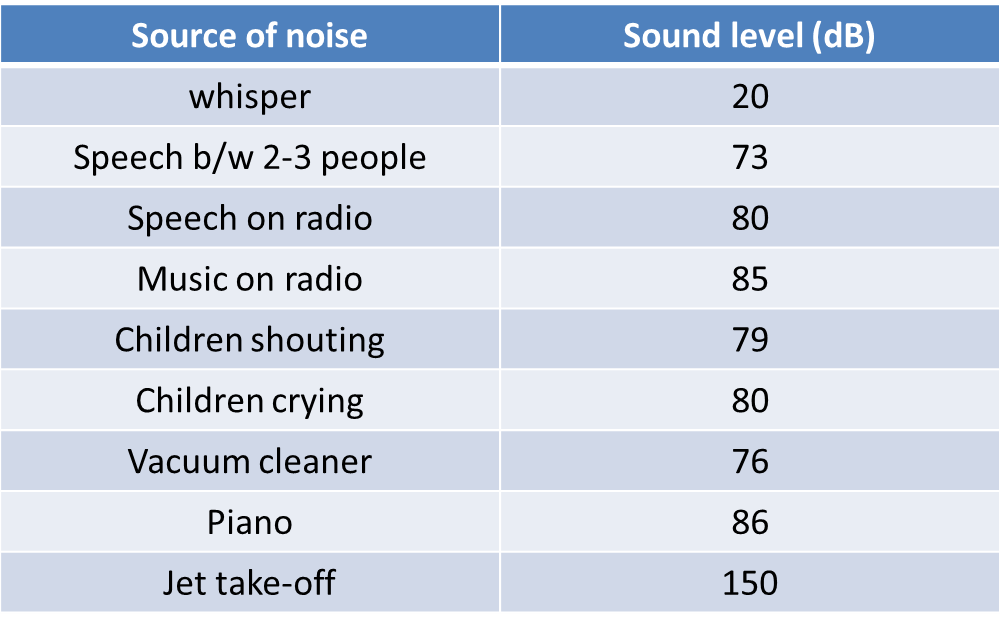
Some Everyday Sound Levels
| Source of noise | Sound level (dB) |
|---|---|
| Whisper | 20 |
| Speech b/w 2-3 people | 73 |
| Speech on radio | 80 |
| Music on radio | 85 |
| Children shouting | 79 |
| Children crying | 80 |
| Vacuum cleaner | 76 |
| Piano | 86 |
| Jet take-off | 150 |
Original image
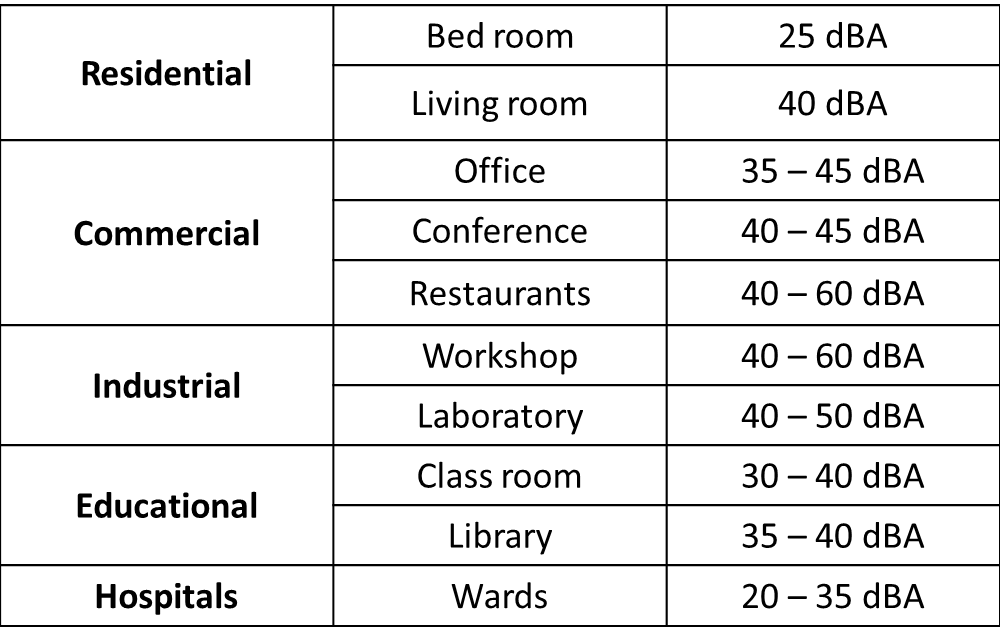
Acceptable Levels of Noise
| Residential | Bed room | 25 dBA |
|---|---|---|
| Living room | 40 dBA | |
| Commercial | Office | 35 – 45 dBA |
| Conference | 40 – 45 dBA | |
| Restaurants | 40 – 60 dBA | |
| Industrial | Workshop | 40 – 60 dBA |
| Laboratory | 40 – 50 dBA | |
| Educational | Class room | 30 – 40 dBA |
| Library | 35 – 40 dBA | |
| Hospitals | Wards | 20 – 35 dBA |
Original image
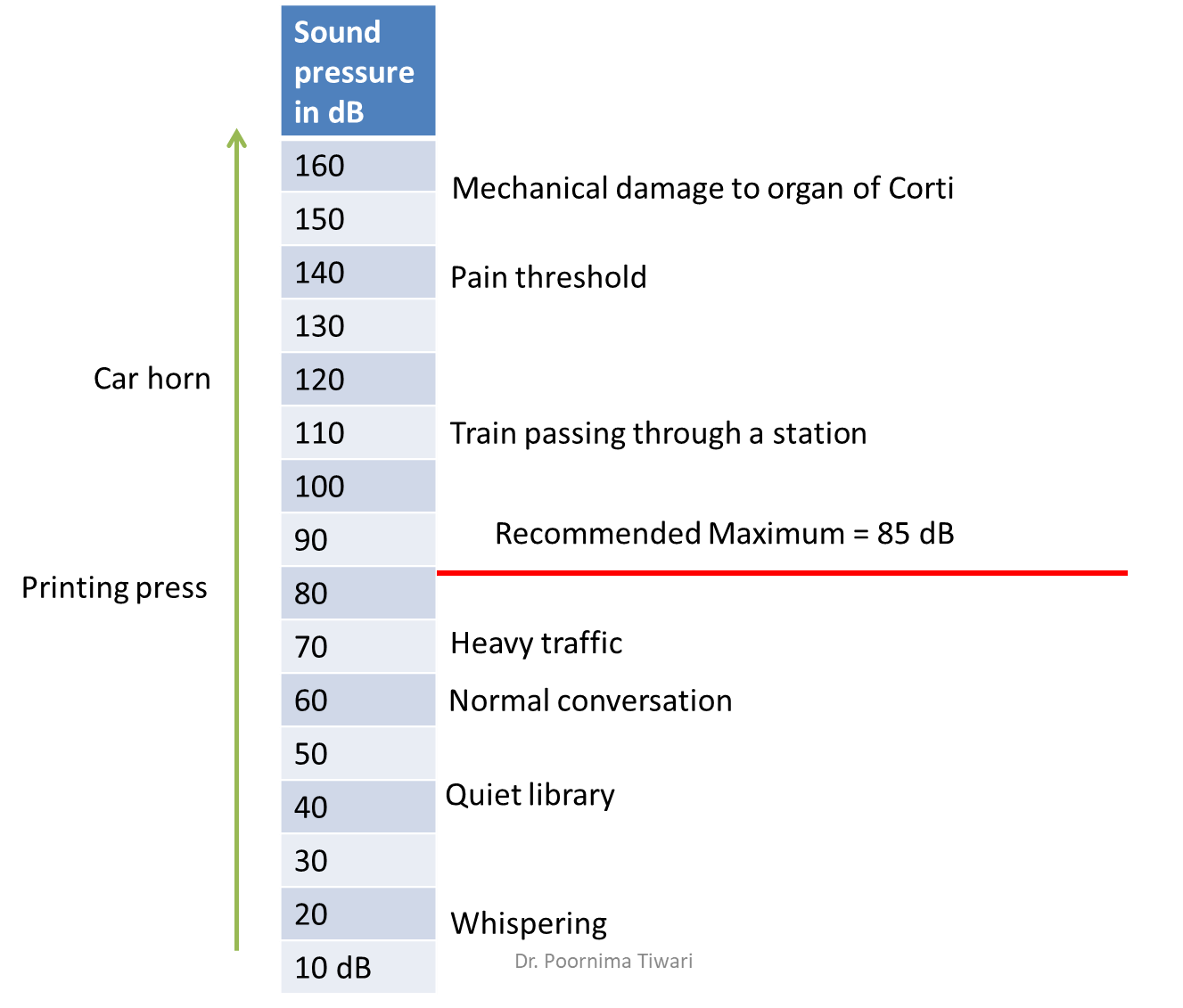
Cut-off levels of sounds
Instruments used in Studying Noise
1. Sound level meter:
- Measures intensity of sound in dB or dBA
2. Octave band frequency analyzer:
- Measures noise in octave bands
- Creates a plot showing the ‘sound spectrum’
- Indicates the characteristics of the noise
- Mainly high pitch
- Mainly low pitch or
- Variable pitch
3. Audiometer:
- Machine used for evaluating hearing capability
- Zero line at the top of audiogram represents normal hearing.
- Noise induced hearing loss shows a characteristic dip in the curve at the 4000 Hz frequency
Health Effects of NOISE
- Auditory
- Non – Auditory
Auditory effects
Auditory fatigue: whistling and buzzing in ears
- Appears at 90 dB and affects most the frequency of 4000 Hz
Deafness or hearing loss
- Victim usually unaware esp. initial stages
- Temporary/ permanent
Temporaryhearing loss
- Exposure to one episode of loud noise
- Disappears after some time (up to 24 hr.) following the exposure
- Most affected frequency: 4000 – 6000 Hz
Permanenthearing loss
- Repeated /continuous exposure to 100 dB
- Occupational hearing loss is due to this
- Exposure to > 160 dB may even rupture the tympanic membrane
Non – Auditory Effects of Noise Exposure
- Interference with speech: speech level needs to exceed ambient sound by 12 dB
- Annoyance
- Efficiency reduction
- Physiological changes
- Stress hormones
- Rise in BP
- Rise in intracranial pressure
- Increase in heart rate
- Interference in sleep
Economic loss
- Less productivity: reduced efficiency, workers in noisy conditions have been found to be more irritated, short fuse and quicker to agitate and halt production
- Occupational health claims to industry
Control of Noise Pollution
1. Cautious planning of cities
- Separate industrial and transport zone
- Separation of residential areas from main streets by green belts
- Houses not < 15 m from main street, thick plantation
- Widening of main streets
2. Control of vehicles
- Heavy vehicles not allowed in narrow streets
- Prohibit indiscriminate blowing of horn
Reference
- Park’s Textbook of PSM. 25th ed. 2019 Bhanot Publishers, Jabalpur
- Mathias Basner, Wolfgang Babisch, Prof. Adrian Davis, Mark Brink, Charlotte Clark, Sabine Janssen, Prof. Stephen Stansfeld Auditory and non-auditory effects of noise on health .Lancet. 2014 Apr 12; 383(9925): 1325–1332
- Stephen A Stansfeld and Mark P Matheson. Noise pollution: non-auditory effects on health British Medical Bulletin 2003; 68: 243–257